Bunker - Facts Thomas Feuerer When in Rieb close Hemau situated former "basic network, switching and exchange Bundeswehr 64" it was a military of 32 bunkered telecommunications services who, in the sixties of the 20th century was built almost identical throughout the former federal territory. This GSVBw were the focal points of the so-called army base network and featured as its "backbone" in particular the telecommunication connections in the fixed telecommunications network Bundeswehr sure defense should the case as well as connection points the fighting troops serve. background Building a whole network of bunkered GSVBw as part of a comprehensive defense infrastructure was of the command staff of the armed forces already in their development phase has been recognized as absolutely necessary. NATO strategy and national defense planning saw declines consistently in the 1950s expect that in the case of a then very likely held attack would be broken up by troops of the Warsaw Pact, the Federal Republic of Germany shooting up into four or five defensive Islands. citing expected in this context mass using tactical Nuclear weapons and the harm it does enormous damage was feared, however, that then would be a centrally controlled political and military coordination or management of the defense in and between these fragmented subdivisions no longer possible . From the perspective of the operations staff of the Bundeswehr, it became imperative as soon as possible from high-risk public telecommunications network independent and thus more secure backbone to create its own military. The implementation of the 1958 claims, was first described in detail do it now under way. But only at the instigation of the army leadership in June 1961 beschlossene Aufstellung einer Einheitsplanung beschleunigte den Bau der zahlreich benötigten „Grundnetzvermittlungen der Bundeswehr“ (GVBw). Von nun an sollten die Bauausführungsunterlagen nämlich zentral durch eine „Planungsgruppe GVBw“ erarbeitet und laufend allen zuständigen Bauverwaltungen der Länder für die Durchführung der Baumaßnahmen vor Ort zur Verfügung gestellt werden. Da der Bunker in Rieb bei Hemau der erste war, der tatsächlich errichtet werden sollte, und somit gleichsam der Prototyp für alle anderen im ganzen Bundesgebiet, wurden die Einheitspläne für sämtliche GSVBw daraufhin in Regensburg beim dort ansässigen Financial Building Authority made, and although most of the years from 1961 to 1964. What, however, regards the siting and design, it was the most important criterion of the safety aspect, the attempted those responsible to bear in several respects account: (1) To meet the military demand, potential target areas as to avoid large cities and industrial areas, were up in the late sixties years inside GSVBw built over the entire territory of the former Federal Republic decentralized distributed with a distance of 50 to 80 kilometers and deliberately in a predominantly poor population, predominantly rural regions fit. (2) To maintain the ability to communicate in a nuclear war was believed to have Verbunk the technical facilities at considerable expense to the GSVBw earth atom bomb safe. (3) For the sake of camouflage should finally meet the other required building on settle the earth to the typical style of the modern residential and office building . Description
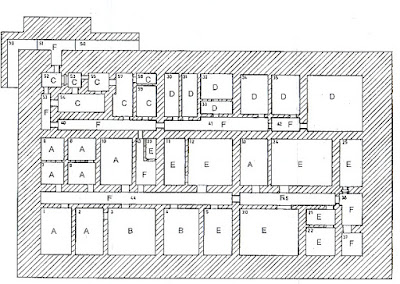
While it is thus, consequently, in the above-ground buildings of the time typical for GSVBw 64 utilitarian concerns, which can not continue to need to be of interest is the underground, in a giant gravel stored in bunkers Rieb undoubtedly a very impressive monument of contemporary history of the Cold War - and not just military-historical perspective. recognize, since the layout of the rooms and their respective purpose very well below the labeled plan can be here only some of the main building data be mentioned in note form: (1) The bunker has a rectangular shape with a length of 49, 50 meters and a width of 29.00 meters. (2) The thickness of the concrete outer walls and the bottom plate is continuously 3.00 meters, while that of the inner walls varies zwischen 0,30 Meter und 1,00 Meter. (3.) Die Bunkerdecke ist in Form eines flachen Satteldaches gegossen, um ein Ablaufen des Wassers zu gewährleisten. An den Längsseiten beträgt ihre Betondicke daher ebenfalls 3,00 Meter, am Scheitel aber ca. 3,60 Meter. (4.) Der gewaltige Kubus, dessen Sohlentiefe sich ab Oberkante Gelände auf ca. 9,50 Meter beläuft, ruht auf einem etwa 1,00 Meter tiefen Kiesbett.
Sinn und Zweck des Bunkers war es ja, den militärischen Fernmeldebetrieb auch im Falle eines atomaren Schlagabtausches zumindest noch für einen gewissen Zeitraum mehr oder weniger reibungslos aufrecht erhalten to. It was therefore done everything to make the building self-sufficient as possible. Prerequisite for first was once the possibility of hermetic, radiation-safe closure of the entrance using gas-tight blast doors or securing integrated gas lock system (to decontamination purposes). then had to be kept in sufficient volume for the trapped crew in addition to the required offices and workrooms also an emergency kitchen, a catering space and sanitary facilities and rest rooms . The supply of the necessities of life such as water, air, energy and food finally was ensured as follows: (1) For an independent water supply had to go through the well 90 meters deep wells (power: 9 liters / second) and a constant supply of water held by of 8,000 liters of drinking water provided. (2) For the artificial ventilation of the entire bunker complex was required hourly approximately 10,000 m3 of air that had been cleaned in an emergency by a special sand filters. (3) In the event that there were no external power supply more, for a was a large battery has been installed to take that could have had about eight hours, the entire supply of bunker können. Zum anderen waren ein Siemensgenerator mit einem 8-Zylinder Dieselmotor (168 PS) und eine Kühlmaschine eingebaut worden, wofür wiederum ständig ein Kraftstoffvorrat von 27.000 Liter Diesel und 1.000 Liter Öl bereit gehalten wurde. (4.) Der permanent eingelagerte und regelmäßig erneuerte Verpflegungsvorrat schließlich hätte 27 Tage für 67 Personen gereicht. Als ganz besonders charakteristisches Baumerkmal des Bunkers soll nicht unerwähnt bleiben, dass sämtliche festinstallierte Einrichtungen (insbesondere die technischen Geräte, aber auch die Lampen und Ruheliegen) freischwingend eingebaut waren, um im Ernstfall auch größere Erschütterungen unbeschadet überstehen zu können. Angeblich hätte sich dadurch der Bunker – selbst im Falle von Atombombendetonationen in nächster Nähe – in seinem Kiesbett verschieben können, ohne dass dabei seine Funktionsfähigkeit entscheidend gelitten hätte (vermuteter Spielraum: bis zu 50 cm). Lediglich ein sogenannter „atomarer Steckschuß“ wäre demnach nicht zu kompensieren gewesen. Bau und Betrieb Nachdem der erwähnte Tiefbrunnen schon zwischen dem 16. Februar und dem 26. September 1960 gebohrt worden war, begannen die Arbeiten am Bunker selbst erst am Pfingstdiensttag (12. Juni) des Jahres 1962. Schon während der Bauzeit galten sehr strenge Sicherheitsvorkehrungen. So wurde die Baustelle zum Beispiel umgehend mit einem hohen Bretterzaun eingefasst, wodurch das Gelände von außen praktisch nicht mehr einsehbar war. Außerdem patrouillierte Tag und Nacht eine Zivilwache. Um möglichst zügig voranzukommen, wurde die Baustelle als Winterbaustelle eingerichtet. Man arbeitete also das ganze Jahr über ohne nennenswerte Unterbrechung. Selbst Betonierungsarbeiten wurden zum Teil bei zweistelligen Minusgraden ausgeführt (mit vorgeheiztem Wasser und angewärmtem Kies etc.). Zeitweise waren in Rieb bis zu 120 Mann beschäftigt, darunter viele aus dem Bayerischen Wald. Nach der Fertigstellung des Bunkers und der Gebäude konnte die Anlage im Mai 1965 vorläufig in Betrieb genommen werden. Am 28. und 29. Oktober 1965 schließlich erfolgte die offizielle Begehung und Übergabe der GSVBw 64 an den künftigen Nutzer, nämlich an das Wehrbereichskommando VI, Abteilung Fernmeldewesen, und an Stabsfeldwebel Bauer, den ersten Dienststellenleiter in Rieb. Die Kosten beliefen sich am Ende insgesamt auf geschätzte 12 bis 15 Millionen DM. Da der Gesamtkomplex in erster Linie eine militärische Dienststelle war, hatten Soldaten selbstverständlich auch die führenden Funktionen inne. So war etwa der Dienststellenleiter für gewöhnlich ein Offizier im The rank of captain. Then there were usually still total 4 Sergeant Guard service: 2 by the Army, 1 from the Air Force and one of the Navy. In comparison, the number of civil servants of both sexes was much higher. Overall, there were usually about 30 people who worked in Rieb were: 5 in the technical field, 1 as drivers and 12 each as telephone and telex as . There was also a security service with about 5 men and 2 dogs, which first of the army, but was subsequently provided by a private company , and also 2 employees of Deutsche Bundespost, which were for the maintenance the sound system responsible. The three-shift operation ran 365 days a year, 24 hours. While peacetime per shift usually 10 people in the bunker, worked in an emergency one spiked with reservists crew of about 67 men under the earth would have been - including the way no female employees more because they can be before, "on leave" would have. resolution and sale Contemporary and after the reunification of Germany created telecommunications system of the Bundeswehr with its new network structure and technology, the automated operating procedures and the increasing digitization had become technically obsolete GSVBw lost their right to exist. Therefore wurde im Mai 1996 auch die Anlage in Rieb bei Hemau außer Dienst gestellt und Anfang Februar 1999 von der Bundesagentur für Immobilienaufgaben an die Firma Holzbau Semmler verkauft. Den Bunker hatte man zuvor beinahe vollständig geräumt............
Adresse: "Der Bunker" Rieb bei Hemau dienstags und donnerstags auf Anmeldung (09491/94 11 10) samstags und sonntags 11.00 bis 18.00 Uhr to 27 August 2006